

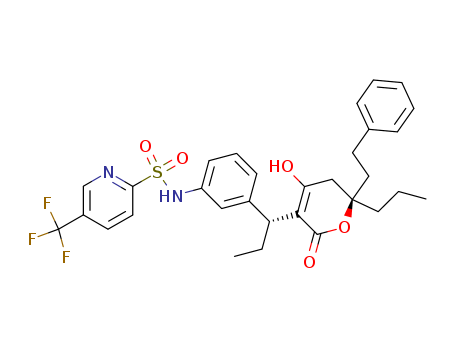
- Product Name Tipranavir
- cas 174484-41-4
- purity 99%

Pharmaceutical
Factory Sells Best Quality Tipranavir 174484-41-4 with GMP standards
- Molecular Formula: C31H33F3N2O5S
- Molecular Weight: 602.675
- Appearance/Colour: White Solid
- Vapor Pressure: 0mmHg at 25°C
- Melting Point: 86-89 °C
- Refractive Index: 1.579
- Boiling Point: 680 °C at 760 mmHg
- PKA: 4.50±1.00(Predicted)
- Flash Point: 365.1 °C
- PSA: 113.97000
- Density: 1.313 g/cm3
- LogP: 8.47930
Tipranavir(Cas 174484-41-4) Usage
|
Acquired resistance |
In a study of 105 viruses resistant to other protease inhibitors, 90% exhibited a more than four-fold decrease in susceptibility and 2% high-level resistance (>10-fold decrease). The predominant emerging mutations in use with ritonavir are L33F/I/V, V82T/L and I84V. Combination of all three of these mutations is usually required for reduced susceptibility. Mutations at positions 47, 58 and 74 are also associated with resistance. |
|
Pharmaceutical Applications |
A non-peptidic protease inhibitor formulated as capsules or solution for oral use. |
|
Mechanism of action |
Tipranavir appears to be bound to the same active site of HIV-1 protease as the peptidomimetics are, but because of its different chemical structure, cross-resistance is significantly less than that seen between the peptidomimetics. The drug suppresses viral replication in various strains of HIV-1 in vitro, and when combined with azothymidine or delaviridine, synergistic activity is noted in vitro. Tipranavir has an advantage over the other PIs in that it is not as strongly bound to plasma protein as the earlier PIs are, a property that reduces the 90% inhibition concentration. |
|
Pharmacokinetics |
Oral absorption: Not known/available Cmax 500 mg + 200 mg ritonavir twice: c. 57.2 mg/L (female); daily: 46.8 mg/L (male) Cmin 500 mg + 200 mg ritonavir twice: c. 25.1 mg/L (female); daily: 21.5 mg/L (male) Plasma half-life: c. 5.5 h (female); 6 h (male) Volume of distribution: Not known/available Plasma protein binding: >99.9% Absorption and distribution The combination with ritonavir may be taken with or without food. No studies have been conducted to determine the distribution into human CSF, semen or breast milk. Metabolism and excretion Metabolism in the presence of 200 mg ritonavir is minimal. Around 82% is excreted in the feces and 4% in the urine. In mild hepatic impairment it should be used with caution; it should not be used in moderate or severe hepatic impairment. |
|
Side effects |
Adverse effects include nausea, vomiting, diarrhea, fatigue and headache. In studies of ritonavir-boosted regimens higher rates of hepatotoxicity have been observed with tipranavir than with other protease inhibitors. In addition, 14 reports of intracranial bleeding (eight fatal cases) associated with tipranavir have been reported. It has been associated with dyslipidemia to a greater extent than other protease inhibitors. |
|
Synthesis |
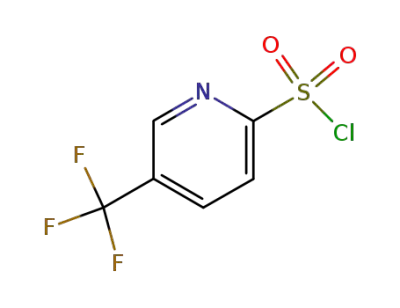
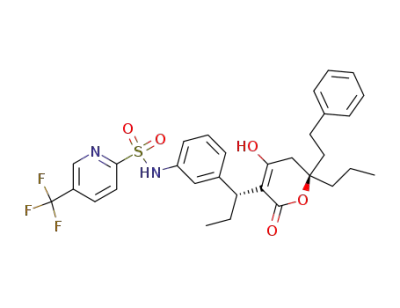
Synthesis of tipranavir was assembled by an aldol condensation between two chiral key intermediates, 149 and 154. Condensation of 1-phenylhexan-3-one (141) with ethyl acetate in the presence of butyllithium and diisopropylamine in THF gave racemic 3-hydroxy-3-(2-phenylethyl)hexanoic acid ethyl ester, which was directly hydrolyzed with NaOH in methanol to corresponding free acid 142 in 94% yield. The racemic 142 was subjected to optical resolution with (1R, 2S)-(-)-norephedrine to yield chiral compound 144 which was alkylated with 4-biphenylyloxymethyl chloride (POMCl) and diisopropylethylamine in toluene to give POM protected ester 146 in 73% yield . The choice of POM protection group is for the purification since the POM protected intermediates were highly crystalline compounds. The ester group of 146 was reduced with diisobutylaluminum hydride in toluene to give corresponding alcohol 147 in 78% yield, which was oxidized with 4-hydroxy-2,2,6,6-tetramethylpiperidinyloxy radical (TEMPO)/bleach (NaOCl) to yield corresponding aldehyde 149 in 99% yield. The other chiral intermediate 154 was synthesized as described below. Racemic compound 150 was subjected to kinetic enzymatic resolution with a lipase and isopropenyl acetate in dichloromethane to give chiral alcohol 152 which was converted to its mesylate and reacted with sodium diethyl malonate to give diester 153. The diester 153 was decarboxylated under an acid condition and re-esterified to give optical pure intermediate 154. Aldol condensation of 149 and 154 with sodium hexamethyldisilazide in THF at low temperature gave hydroxyester 155 in 90% yield as a mixture of four diastereomers. This mixture was oxidized with pyridinium chlorochromate (PCC) in dichloromethane to afford corresponding ketoester which was subsequently treated with sulfuric acid in methanol to remove the POM protecting group to yield hydroxy ketoester 156 in 84% yield. Compound 156 was cyclized with NaOH in methanol/water to afford dihydropyranone 157 in 75% yield. The nitro group of 157 was reduced with hydrogen over Pd/C in THF to give corresponding aniline 158, which was finally amidated with 5-(trifluoromethyl)pyridine-2- sulfonyl chloride 159 and pyridine in DMSO to give tipranavir (XXI) in 78% yield from compound 149. |
|
Drug interactions |
Potentially hazardous interactions with other drugs Antacids: avoid giving for 2 hours after tipranavir administration. Antibacterials: plasma concentration of clarithromycin and other macrolides increased - reduce dose of clarithromycin in renal impairment; concentration increased by clarithromycin; rifabutin concentration increased (risk of uveitis) - reduce dose; concentration possibly reduced by rifampicin - avoid; avoid with telithromycin in severe renal and hepatic failure. Anticoagulants: avoid with apixaban and rivaroxaban. Antidepressants: concentration possibly reduced by St John’s wort - avoid. Antimalarials: use artemether/lumefantrine with caution; concentration of quinine increased. Antipsychotics: possibly increases aripiprazole concentration - reduce aripiprazole dose; possibly increases quetiapine concentration - avoid. Antivirals: reduces concentration of abacavir, dolutegravir, didanosine, fosamprenavir, lopinavir, saquinavir and zidovudine; concentration increased by atazanavir, also concentration of atazanavir reduced; concentration reduced by etravirine, also concentration of tipranavir increased - avoid. Beta-blockers: avoid with metoprolol for heart failure. Ciclosporin: levels possibly altered by tipranavir. Cobicistat: concentration of both drugs reduced - avoid. Lipid-lowering drugs: increased risk of myopathy with atorvastatin, max dose 10 mg; avoid with lomitapide; concentration of rosuvastatin increased - reduce rosuvastatin dose; concentration of simvastatin increased - avoid.1 Orlistat: absorption possibly reduced by orlistat. Ranolazine: possibly increases ranolazine concentration - avoid. Sirolimus: levels possibly altered by tipranavir. Tacrolimus: levels possibly altered by tipranavir. Ulcer-healing drugs: concentration of esomeprazole and omeprazole reduced. |
|
Metabolism |
Tipranavir is metabolised by the cytochrome P450 system (mainly the isoenzyme CYP3A4), although when given with ritonavir metabolism is minimal with the majority of tipranavir being excreted unchanged in the faeces. |
|
Definition |
ChEBI: A pyridine-2-sulfonamide substituted at C-5 by a trifluoromethyl group and at the sulfonamide nitrogen by a dihydropyrone-containing m-tolyl substituent. It is an HIV-1 protease inhibitor. |
|
Brand name |
Aptivus |
|
General Description |
Tipranavir is unique among the PIs because it is not a peptidomimeticcompound. It does appear to bind to the activesite of HIV-1 protease the same as the peptidomimetics do.The benefit of this agent is that, because it is a differentchemical structure, cross-resistance does not develop tothe same extent as seen with the peptidomimetics. Thedrug is administered with a booster dose of ritonavir. Thisprotocol inhibits CYP3A4, causing the levels of tipranavirto increase. |
InChI:InChI=1/C31H33F3N2O5S/c1-3-16-30(17-15-21-9-6-5-7-10-21)19-26(37)28(29(38)41-30)25(4-2)22-11-8-12-24(18-22)36-42(39,40)27-14-13-23(20-35-27)31(32,33)34/h5-14,18,20,25,36-37H,3-4,15-17,19H2,1-2H3/t25-,30-/m1/s1
174484-41-4 Relevant articles
Process for asymmetric hydrogenation
-
, (2008/06/13)
The present invention is a process for t...
Process to produce a protease inhibitor
-
, (2008/06/13)
Disclosed is a novel process and novel i...
Tipranavir (PNU-140690): A potent, orally bioavailable nonpeptidic HIV protease inhibitor of the 5,6-dihydro-4-hydroxy-2-pyrone sulfonamide class
Turner, Steve R.,Strohbach, Joseph W.,Tommasi, Ruben A.,Aristoff, Paul A.,Johnson, Paul D.,Skulnick, Harvey I.,Dolak, Lester A.,Seest, Eric P.,Tomich, Paul K.,Bohanon, Michael J.,Horng, Miao-Miao,Lynn, Janet C.,Chong, Kong-Teck,Hinshaw, Roger R.,Watenpaugh, Keith D.,Janakiraman, Musiri N.,Thaisrivongs, Suvit
, p. 3467 - 3476 (2007/10/03)
A broad screening program previously ide...
A convergent, scalable synthesis of HIV protease inhibitor PNU-140690
Fors, Kristina S.,Gage, James R.,Heier, Richard F.,Kelly, Robert G.,Perrault, William R.,Wicnienski, Nancy
, p. 7348 - 7356 (2007/10/03)
PNU-140690, an inhibitor of the HIV prot...
174484-41-4 Process route
-
-
174485-72-4
5-trifluoromethyl-pyridin-2-ylsulfonylchloride

-
![(R)-3-[(R)-1-(3-Amino-phenyl)-propyl]-4-hydroxy-6-phenethyl-6-propyl-5,6-dihydro-pyran-2-one](/upload/2026/6/78946e3387f1474ca8c3d150bb01dcd9_2c4928b3-3bba-4c9a-a0d0-f74a34a8379f.png)
-
174485-90-6
(R)-3-[(R)-1-(3-Amino-phenyl)-propyl]-4-hydroxy-6-phenethyl-6-propyl-5,6-dihydro-pyran-2-one

-
-
174484-41-4,174484-81-2,174590-27-3
tipranavir
Conditions
| Conditions | Yield |
|---|---|
|
With
pyridine;
In
dichloromethane;
|
81%
|
|
With
pyridine;
In
dichloromethane;
at 0 ℃;
|
-
-
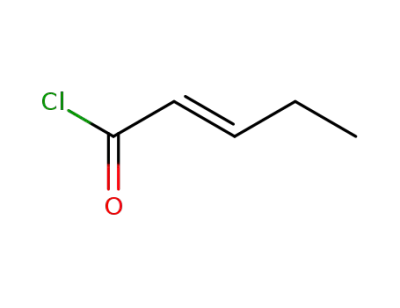
33698-85-0
(E)-pent-2-enoyl chloride
-
-
174484-41-4,174484-81-2,174590-27-3
tipranavir
Conditions
| Conditions | Yield |
|---|---|
|
Multi-step reaction
with
8
steps
1: 95 percent / n-BuLi / tetrahydrofuran / -78 °C
2: CuBr, DMS / tetrahydrofuran / 1 h / 0 °C
3: 1.) H3
O+
, 2.) Na2
CO3
/ 2.) H2
O, CH2
Cl2
6: 67 percent / t-BuOK / tetrahydrofuran / 0 °C
7: H2
/ Pd/C / methanol; ethyl acetate
8: 81 percent / pyridine / CH2
Cl2
With
pyridine; n-butyllithium; 2,3-dimercapto-succinic acid; oxonium; potassium tert-butylate; hydrogen; sodium carbonate; copper(I) bromide;
palladium on activated charcoal;
In
tetrahydrofuran; methanol; dichloromethane; ethyl acetate;
|
174484-41-4 Upstream products
-
174485-72-4
5-trifluoromethyl-pyridin-2-ylsulfonylchloride
-
174485-90-6
(R)-3-[(R)-1-(3-Amino-phenyl)-propyl]-4-hydroxy-6-phenethyl-6-propyl-5,6-dihydro-pyran-2-one
-
174485-71-3
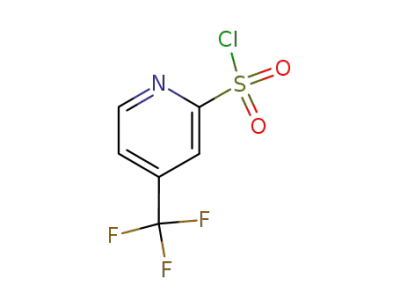
4-(trifluoromethyl)pyridine-2-sulfonyl chloride
-
29898-25-7
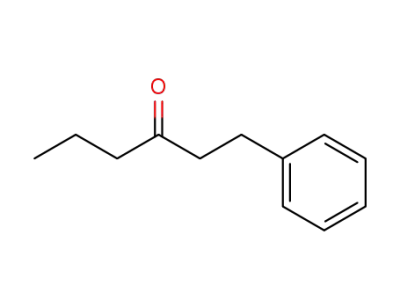
1-phenylhexan-3-one


The order has been successfully placed. Our staff will contact you within 24 hours.